Zoysiagrass
The dense, fine-bladed compromise between bermuda and St. Augustine — more cold-hardy than either, more shade-tolerant than bermuda, and slower than both to fill in and to heal. A healthy zoysia lawn is thick enough to crowd out most weeds on its own, and it asks for less mowing and less nitrogen than bermuda to stay that way. The catch is patience. It takes a season or two to establish, it is usually the last grass on the block to green up in spring, and when something tears it up it does not bounce back fast. If you can pay for sod or wait out plugs, few lawns look better. If you need a lawn established or repaired in a hurry, keep reading — this isn't the one.
What zoysia tolerates, and what it doesn't
Ratings are relative to other lawn grasses, not absolute. Zoysia's profile is the most balanced of the warm-season grasses — good almost everywhere — with one deliberate weakness that is really the price of everything else: it grows slowly, so it is slow to recover.
Not all zoysia looks the same
Zoysia is really three species sold under one name, and the named cultivar changes almost everything you care about — leaf texture, colour, cold hardiness, shade tolerance, how low you can cut it, and whether you can start it from seed at all. The broad-bladed japonica types are the tough, easy-care, cold-hardy end; the fine matrella types are the carpet-soft, shade-tolerant, higher-maintenance end. These are the ones a homeowner is actually offered. The choice is worth making deliberately, because you live with it for a decade.
The old benchmark, the japonica selection that made zoysia a transition-zone lawn grass in the first place. Medium texture and the best cold hardiness of the common cultivars — this is the one that holds where bermuda winterkills. The trade-offs are the ones zoysia is known for: it is slow to establish, slow to green up in spring, and more prone to billbugs and nematodes than newer types. Plug or sod only.
The seeded option, and the way to get a zoysia lawn without paying for sod or waiting out plugs. A coarser-bladed japonica with decent colour and moderate cold hardiness. The catch is what you give up: it is still slow from seed, weeds crowd the gaps during the long fill-in, and you cannot get the fine premium texture this way. Cheapest by a wide margin.
A broad-bladed japonica bred to be forgiving: strong drought and cold tolerance, good insect and disease resistance, and it takes a standard rotary mower at 1.5 to 2 inches without complaint. If you want zoysia's density without the reel-mower discipline the fine types demand, this is the easy-care pick — and it is one of the most widely available zoysia sods. Palisades is a close, coarser cousin with the same low-maintenance appeal.
A fine-textured matrella, dark green and soft underfoot, with the best shade tolerance of the group and good drought performance. This is the one people mean when they picture a manicured, carpet-like zoysia lawn. It rewards a low reel cut and asks for more attention than the coarse japonicas — dethatching and a tighter mowing routine — and it is less cold-hardy than Meyer. Plug or sod only.
The finest, densest, darkest zoysia on this list — a japonica-by-pacifica hybrid that looks superb and takes light shade well. It is also the highest-maintenance of the bunch: it builds thatch quickly, wants a low reel cut to look its best, and is less winter-hardy than Meyer, so it can take cold injury at the northern edge of the range. Choose it for looks, and only if you will maintain it. Plug or sod only.
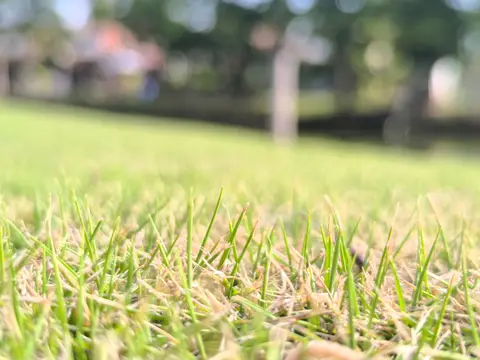
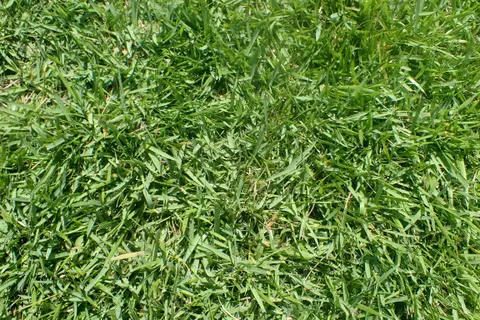
What it actually looks like
Species-level photographs of an established stand, the blade and canopy up close, and — where one exists — the off-season colour.
Four honest reasons to choose something else
Zoysia is a genuinely great lawn for the right yard, but it is oversold to people who need speed. Every one of these is a common, expensive mistake.
Zoysia is the slowest common lawn grass to fill in — plugs can take one to two full growing seasons, and seed is slower still. If you need cover this year without paying for sod, this isn't it.
Dogs, a worn path, kids on the same patch all summer — zoysia takes the wear but heals slowly, so damage lingers for weeks. Fast recovery is bermuda's job, not zoysia's.
Zoysia handles light and partial shade better than bermuda, but under mature trees or a north wall with only a few hours of sun it still thins out. Moderate shade is its ceiling, not deep shade.
It goes fully tan after the first hard frost and is typically the last warm-season grass to wake up in spring. That's normal, not damage — but it is a long brown season.
Slow growth is the whole personality
Zoysia grows slowly, and almost everything good and bad about it comes back to that. On the good side, you mow it less than bermuda — usually about once a week in peak growth instead of two or three times. Most home lawns sit between 1.5 and 2 inches with a standard rotary mower. Fine-textured cultivars like Zeon, Emerald, and the matrella types will take a half-inch to an inch cut, but that puts you into reel-mower and plant-growth-regulator territory, the same as low-cut bermuda.
The leaf blades are stiff and tough — that density is what makes zoysia feel like carpet, and it is also what dulls a mower blade faster than any other lawn grass here. Sharpen more often than you think you need to; a dull blade shreds zoysia and leaves a grey, frayed cast across the lawn.
Follow the one-third rule, and be more disciplined about it than you would with bermuda. Because zoysia recovers slowly, it is less forgiving of a scalp — if you let it get tall and then cut it back to height, the brown will sit there for weeks, not days. The one exception is a deliberate early-spring scalp to clear dormant tissue, covered under dormancy below.
A modest appetite, and a hard fall deadline
Zoysia is not a hungry grass. Roughly 2 to 3 pounds of nitrogen per 1,000 square feet per season keeps a home lawn healthy, applied in half-pound increments spaced three to four weeks apart while it is actively growing. Sandy soils in the Deep South run toward the top of that range, sometimes to 4; heavier clay soils sit at the bottom. Zoysia responds better to this kind of light, frequent spoon-feeding than to a couple of heavy dumps.
The timing rule matters more than the total, and it is stricter than bermuda's for one reason: large patch. Start nitrogen only after the lawn has fully greened up in spring — not at the first warm week — and stop by late summer, roughly six weeks before your average first frost. Nitrogen applied late into fall or too early in spring is the single biggest driver of large patch, the disease that defines zoysia. Feed it on time and you avoid most of the trouble in the diseases section below.
The full seasonal schedule, with the soil-temperature triggers, lives in the warm-season calendar. Get a soil test before buying anything with phosphorus or potassium in it — zoysia rarely needs either in the amounts a bagged 'lawn food' provides.
The slowest lawn to start — plan around it
Establishment is zoysia's real drawback, and it is worth understanding before you buy. Like bermuda, zoysia roots best when it is growing hardest, so the window is late spring through early summer once soil temperatures are reliably warm. Unlike bermuda, it takes its time closing in no matter what you do. Whatever method you choose, the first season is mostly about keeping the area clean while the grass runs together.
Only the coarse japonica types (Zenith, Compadre) are sold as seed, at 1–2 lb per 1,000 sq ft into warm soil. Cheapest by far, but slow to fill, prone to weeds in the gaps, and you cannot get the premium fine-textured cultivars this way.
How you get a premium cultivar without paying for full sod: 2-inch plugs on 6-inch centers, spreading to cover in one to two seasons. Cheap, but you are irrigating and weeding between plugs for a long time.
The realistic route to a premium zoysia lawn, and the only fast one. Expensive, but it gives instant cover and shuts out the weeds that plague the slower methods. Buy from a farm that names the cultivar and get it rooted before winter.
Do not apply pre-emergent herbicide to an area you are about to seed or plug — the barrier that stops crabgrass stops zoysia from rooting just as effectively. And because establishment is slow, weed pressure during that long fill-in window is the real fight; start with a clean, weed-free seedbed and stay on top of it.
Handles more than bermuda, asks for patience in return
Shade is where zoysia earns its reputation as the compromise grass. It is not shade-loving, but it holds up in four to six hours of sun and light, dappled shade far better than bermuda does — and the fine-textured matrella cultivars are the most shade-tolerant of the bunch. The ceiling is moderate shade, though. Under mature trees or a north-facing wall with only a couple of hours of direct sun, it thins like everything else, and no fertility program fixes it.
Water demand is about an inch a week during active growth, delivered in one or two deep soakings rather than daily sprinkles. Zoysia's drought response is fast and dramatic: it goes off-color and dormant within about a week of drying out, then greens back up when water returns. That makes it respectably drought-tolerant, just not the equal of bermuda — and, as with bermuda, if you let it go dormant you should commit, because repeatedly half-watering a stressed lawn is worse than leaving it alone.
Cold and traffic are the two places zoysia quietly beats its warm-season peers. It is the most cold-hardy of the group, holding into the transition zone where bermuda winterkills, and its dense turf takes wear well. The asterisk on traffic is recovery: it takes the abuse but heals slowly, so a spot that gets genuinely torn up will stay thin for weeks. That single trade — great wear tolerance, slow recovery — is the most important thing to understand about the grass.
One disease matters, and you prevent it in fall
Zoysia is a tough, low-disease grass with essentially one problem that defines it — large patch — and the thing to understand is that by the time you see it in spring, the decision that caused it was made the previous fall.
The signature zoysia disease. Circular or arc-shaped patches, often yards across, with a telltale orange-bronze margin, appearing in spring as the lawn breaks dormancy from an infection that started the previous autumn. It is favored by late-fall or early-spring nitrogen, overwatering, and heavy thatch. The lever is a preventative fungicide in fall when soil temperatures drop through the 70s — spring sprays are mostly too late — plus cutting off nitrogen early and watering deeply but infrequently.
Small tan spots about the size of a coin, most common on lawns short on nitrogen. Often the fix is fertility rather than fungicide.
Zoysia's main insect pest. Larvae tunnel in stems and crowns, and the damage looks like drought or dormancy that never greens back up. Scout with a tug test — damaged shoots pull free easily and leave sawdust-like frass — and treat when adults are active.
Less of a threat than on bermuda since zoysia is the hardier grass, but young stands, deeply shaded areas, and lawns fed late into fall are still vulnerable at the cold edge. It shows up as areas that simply never green up.
Cultural practice does more than chemistry for almost all of this: right height of cut, morning irrigation, no late-season nitrogen, managing thatch, and holding off spring aeration until the disease window closes. Fungicide timing is covered in the warm-season calendar.
Brown in winter, and the last to wake up
Zoysia goes fully dormant after the first hard frost and stays tan until soil temperatures climb in spring — the same as bermuda, with one difference that catches people off guard: zoysia is usually the slowest warm-season grass to green up. Depending on how far south you are, that is anywhere from three to five months of a brown lawn, and the spring transition drags out longer than the bermuda next door. None of it is damage, and there is nothing to fix.
Because green-up is so slow, patience is the whole game in spring. It can look alarming when a neighbor's bermuda is green and your zoysia still isn't, but forcing it with early nitrogen does not speed things up — it just feeds large patch at the worst possible moment. Hold the first feeding until the lawn is fully green, not just waking up.
Winter overseeding with ryegrass buys you green now and costs you at green-up, when the ryegrass competes with zoysia exactly as it is trying to emerge — and zoysia's already-slow transition makes that collision worse, not better. Most extension programs advise against it for a home lawn. Scalping down to remove dormant leaf tissue in early spring does help: it speeds soil warming and cleans up the stand, as long as you wait until frost risk has passed.
Zoysia vs. bermuda vs. St. Augustine
The three warm-season options most people are actually choosing between. The short version: bermuda for sun and traffic, zoysia for a dense low-input compromise, St. Augustine for shade.
| Trait | Zoysiagrass | Bermudagrass | St. Augustine |
|---|---|---|---|
| Shade tolerance | Moderate | Very poor | Best of the three |
| Traffic and recovery | Good wear, slow to heal | Excellent, fastest | Fair |
| Nitrogen appetite | 2–3 lb N/M | 3–6 lb N/M | 2–4 lb N/M |
| Mowing height | 0.5–2 in | 0.5–1.5 in | 2.5–4 in |
| Mowing frequency | Moderate | Highest | Moderate |
| Texture | Fine to medium | Fine (hybrids) | Coarse |
| Establishment speed | Slowest | Fast | Moderate |
| Main disease | Large patch | Spring dead spot | Grey leaf spot |
| Spreads into beds | Slowly | Aggressively | Moderately |
Keep reading
This page covers the grass. The guides cover the calendar — when to do each thing, and what triggers it.
Photography credits
- RatUnderground — CC BY-SA 3.0 (opens in a new tab) · Source (opens in a new tab)
- Krzysztof Ziarnek, Kenraiz — CC BY-SA 4.0 (opens in a new tab) · Source (opens in a new tab)
Sources
Every agronomic claim on this page traces to a named university extension or USDA publication. Regional programs sometimes disagree; where they do, we say so rather than averaging them.
Educational and regional in nature. Always follow the label on any product you apply — the label is the law, and it supersedes any general guidance here.
You know the grass. Now get the schedule.
Tell LawnDominator you have zoysia and it builds the program around it — nitrogen rate per zone, the fall large-patch window, soil-temperature triggers, and the one thing to do this week. 14 days free, no credit card.