Perennial ryegrass
The fast, tough-wearing quick fix of the cool-season grasses. Nothing else on a lawn germinates like perennial ryegrass — seedlings are up in five to ten days, weeks ahead of Kentucky bluegrass — and once it is up, it takes more foot traffic and play than almost anything else you can seed. That combination is why it is the standard grass for overseeding a worn lawn, patching a bare spot, or greening up dormant bermuda for the winter. The catch is that it is a bunch-type grass: it grows in clumps, it does not spread, and it cannot heal a torn-up patch on its own the way bluegrass does. It is also the least heat- and cold-resilient of the common cool-season grasses, so at the hot or cold edge of its range it thins and can winterkill. For most lawns it earns its place as a component of a seed mix — the part that comes up first and takes the beating — rather than a solo lawn. If you want one grass to carry a whole yard in a harsh climate, keep reading; this probably isn't it on its own.
What perennial ryegrass tolerates, and what it doesn't
Ratings are relative to other lawn grasses, not absolute. Ryegrass's profile is lopsided on purpose: it is the fastest to establish and the toughest under traffic of the cool-season grasses, and it pays for that with a bunch-type habit that can't self-repair and the weakest heat and cold resilience of the common three.
Usually a blend, often in a mix
Perennial ryegrass is almost never sold as a single named cultivar the way bermuda is. You buy it as a blend of several improved turf-type varieties, and more often than not it's already mixed with Kentucky bluegrass or tall fescue. The one decision that actually matters at the store is the same one people get wrong most: buy improved turf-type perennial ryegrass, not the cheap annual (or "forage") ryegrass sitting next to it. Everything below is about buying the right bag.
The standard buy. Modern turf-type cultivars are finer-bladed, denser, and darker than old-line ryegrass, and they're sold as a blend of several of them rather than one variety — that genetic spread is deliberate, so a disease or stress that hits one cultivar doesn't take the whole stand. Look for a named blend of improved turf types, ideally ones with NTEP trial data behind them, and skip the generic "perennial ryegrass" with no cultivars listed on the tag.
A real selection criterion, not marketing. Many turf-type ryegrasses carry a beneficial fungal endophyte that lives inside the plant and deters surface-feeding insects — chinch bugs, billbugs, sod webworms — giving the stand built-in resistance without an insecticide. If the tag advertises high endophyte or names an insect-resistant blend, that's a genuine reason to pay a little more. Endophyte viability fades with age and heat, so buy fresh seed and store it cool.
Its two most common real-world jobs. As a minority component of a cool-season mix, it germinates first and takes the wear while slower bluegrass or fescue fills in behind it — keep it a minor fraction so it doesn't crowd them out. For winter overseeding, it's the go-to for greening up dormant bermuda or other warm-season lawns, up in days and gone again when the heat returns. Either way you're buying it for speed and toughness as a component, not as a solo lawn.
What it actually looks like
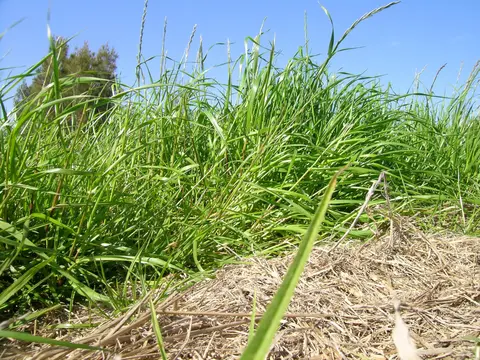
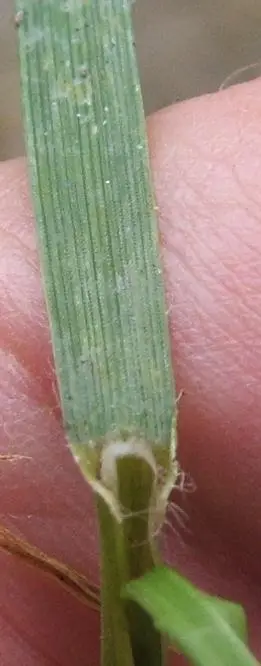
Species-level photographs of an established stand, the blade and canopy up close, and — where one exists — the off-season colour.
Four honest reasons to choose something else
Perennial ryegrass is a genuinely useful grass — often the best thing to seed for a quick, tough result — but it is sold as a solo lawn to people whose climate or expectations don't fit. Each of these is a common mistake.
Ryegrass grows in bunches and has no rhizomes or stolons, so it cannot creep in to close a bare patch. Every worn spot has to be reseeded. If you want a lawn that knits its own damage shut, that's bluegrass's job.
It is the least heat-tolerant of the common cool-season grasses, and hot, humid weather is when gray leaf spot can wipe out a stand — especially young seedings. In the transition zone a deeper-rooted grass carries summer far better.
Ryegrass is less winter-hardy than Kentucky bluegrass and prone to ice and desiccation damage, so in hard-freeze climates it can winterkill in patches. As a solo lawn that far north it's a gamble; in a mix it's fine.
This is a full-sun grass. Under trees or a north wall it stays thin and weak and loses ground to finer grasses and moss. Moderate-to-heavy shade is a hard no for ryegrass.
Fast growth in the cool months, and a real mowing tempo
Perennial ryegrass grows fast when the weather suits it — spring and fall, at soil temperatures in the 60s and low 70s — and that shows up as mowing frequency. Expect to be out there once or twice a week through the cool season, more than you'd mow bluegrass, because ryegrass simply pushes more top growth when it's happy. General home lawns look and hold best mowed at 1.5 to 2.5 inches.
It tolerates a lower cut than that, but there's a catch: mow it too short and the stand becomes temporary, thinning out and letting annual bluegrass (Poa) invade the gaps a bunch-type grass can't close on its own. Keep it in the 1.5-to-2.5-inch band for a dense, durable lawn and only drop lower if you're managing a fine, high-input turf with a reel.
Ryegrass has tough, fibrous leaf blades with prominent veins, and a dull rotary blade shreds rather than cuts them, leaving a whitish, frayed cast across the lawn. Keep the blade sharp and follow the one-third rule. Because it can't creep to hide damage, clean cutting matters more here than on a self-repairing grass — every ragged, scalped, or thinned area stays exactly where you left it until you reseed.
A moderate-to-high appetite, and disease follows underfeeding
Ryegrass is a moderately hungry grass. For a home lawn, roughly 2 to 4 pounds of nitrogen per 1,000 square feet per season keeps it dense and healthy, spoon-fed in half-pound doses during active spring and fall growth rather than dumped all at once. Penn State puts a Pennsylvania lawn around 3 pounds; heavily irrigated, high-use turf in mild climates runs higher. Feed the cool shoulders of the year and go light in summer, when the grass is already stressed and extra nitrogen just fuels disease.
Fertility is directly tied to disease on this grass, and it cuts both ways. Underfeed it and you invite red thread and rust, which show up first on nitrogen-starved, thinning turf — often the fix is a nitrogen application, not a fungicide. Overfeed it, especially in warm weather, and you push brown patch and other high-nitrogen diseases. The target is steady, moderate feeding through the cool months, covered with soil-temperature triggers in the cool-season calendar.
Get a soil test before you buy anything with phosphorus or potassium in it, and correct low pH — ryegrass performs poorly on infertile, acidic soils. Skip the guesswork on how much to spread and use the fertilizer calculator.
The fastest lawn grass to come up — that's the whole point
Establishment is where ryegrass has no rival. It is seeded, not vegetative, and it germinates in about five to ten days — the quickest of any lawn grass, and well ahead of Kentucky bluegrass, which can take two to three weeks. That speed is the reason ryegrass exists in most seed products: it comes up first, stabilizes the soil, and takes wear while slower, longer-lived grasses fill in behind it. The prime seeding window, like all cool-season grasses, is early fall, when warm soil and cooling air give fast germination and a full season of root growth before summer stress. Early spring is the backup.
One establishment-specific warning: young ryegrass seedlings are the most vulnerable stage for gray leaf spot, which can destroy a new stand in hot, humid weather. That's another reason to seed in the cooling temperatures of fall rather than into summer heat.
Sown at roughly 5–9 lb per 1,000 sq ft into a firm, clean seedbed in early fall. Fastest cover of any lawn grass, and immediately wear-tolerant — but as a bunch-type it fills only from the seed you put down, so sow evenly and don't skimp on the rate.
Its most common role. Blended at a modest percentage with Kentucky bluegrass or tall fescue, it germinates first and holds the site while the slower species establish. Keep it a minority of the mix — too much ryegrass out-competes and crowds the grasses meant to carry the lawn long-term.
The standard fix for a thin or worn lawn, a bare patch, or greening up dormant warm-season turf for winter. Because ryegrass can't spread to heal itself, overseeding is how you repair it — and its speed makes it the tool of choice.
Don't apply a pre-emergent herbicide anywhere you're about to seed — the barrier that stops crabgrass stops ryegrass from rooting just as well. Keep new seedings consistently moist through germination; the shallow-rooted seedlings dry out fast.
Built for sun and traffic, thin-skinned about weather extremes
Sun is non-negotiable. Perennial ryegrass is a full-sun grass that wants five to six or more hours of direct light; in moderate-to-heavy shade it stays thin and weak and cedes ground to finer-textured grasses and moss. No fertility program fixes a shade problem here — if the site is shaded, this is the wrong grass.
Traffic is where it shines and the reason it's everywhere on athletic fields and high-use lawns. Excellent wear tolerance is its defining strength. The permanent asterisk is recovery: it takes the beating but, as a bunch-type with no rhizomes or stolons, it can't grow back into the worn spots the way bluegrass does. Heavy wear that opens the canopy has to be reseeded, not waited out.
Weather extremes are its soft spots. Water demand is about an inch to an inch and a quarter per week, and because the root system is relatively shallow, ryegrass has only moderate drought tolerance — prolonged dry spells cause genuine plant death and patchiness, not a clean dormancy. On the cold end it's less hardy than Kentucky bluegrass and prone to ice and desiccation injury, so it can winterkill at the cold edge of the range. That pair of weaknesses — summer heat and hard winters — is exactly why it's usually one component of a mix in harsh climates rather than the whole lawn.
Gray leaf spot is the one that can wipe out a stand
Ryegrass has a handful of diseases, but one defines it. Gray leaf spot is the signature threat — a hot-weather fungal disease that hits perennial ryegrass hard and can level a new seeding in days. Red thread is the common cosmetic one on underfed lawns. Both are managed as much by culture and fertility timing as by fungicide.
The signature ryegrass disease and the most destructive. It needs several hours of leaf wetness and high humidity at temperatures above about 68 °F, so it strikes in the heat of summer. Watch for small gray-to-brown leaf spots that grow into oblong dark lesions, with wilting that can look like drought. It's most devastating on new seedings — the very speed ryegrass is prized for works against it here. Manage with resistant cultivars, avoiding summer nitrogen and evening irrigation, and preventative fungicide on high-value or newly seeded turf.
A cool-season disease favored by 40–70 °F temperatures and long dew periods. Look for tan-to-pink patches four to eight inches across with distinctive antler-like red threads on the leaf tips. It shows up first on nitrogen-starved turf, so the primary fix is an adequate fertility program — it's largely cosmetic on a home lawn and rarely needs a fungicide.
Favored by hot, humid nights and high nitrogen. More of a concern where ryegrass is pushed with summer fertilizer; the lever is cutting off warm-season nitrogen and watering in the morning so the canopy dries.
Orange-yellow pustules that rub off on shoes and mower, common on slow-growing, underfed ryegrass late in the season. Usually corrected by adequate nitrogen and regular mowing rather than fungicide.
Endophyte-enhanced cultivars add built-in resistance to surface-feeding insects like chinch bugs and billbugs, which is a real reason to buy quality seed. For the diseases, cultural practice does most of the work: adequate but not excessive nitrogen, morning irrigation, sharp mowing, and resistant cultivars. Fungicide timing for gray leaf spot is covered in the cool-season calendar.
Summer is the hard season, not winter
Flip the warm-season script here. Perennial ryegrass is a cool-season grass, so its stress season is summer, not winter. Through most of its range it stays green or semi-green all winter, greening up early in spring. The brown, thin, struggling season is July and August, when prolonged heat — and heat plus humidity — pushes it hardest. This isn't a tidy, protective dormancy like a warm-season grass going tan for the season; heat and drought stress on ryegrass tends to mean actual plant loss and patchiness, because it's the least heat-tolerant of the common cool-season grasses and can't creep back into the gaps.
The summer playbook is defensive. Raise the mowing height toward the top of the range, water deeply and in the morning, and ease off nitrogen so you're not feeding disease into a stressed stand. Expect some thinning in a hot summer and plan to overseed the worst areas in fall — with a bunch-type grass, fall reseeding is the normal way you rebuild density, not a sign anything went wrong.
Winter is the milder concern, but it's real at the cold edge. Ryegrass tolerates cold less well than Kentucky bluegrass and is susceptible to ice sheets and winter desiccation, so in hard-freeze climates it can winterkill in patches while staying green everywhere else. It rarely goes fully off-color the way a warm-season lawn does; more often it holds color and then reveals winter-killed spots at spring green-up, which — again — you fix by overseeding.
Perennial ryegrass vs. Kentucky bluegrass vs. tall fescue
The three cool-season grasses most often blended or chosen between. The short version: ryegrass for speed and traffic, bluegrass for a self-repairing sod, tall fescue for heat and drought toughness. In practice they're often mixed, ryegrass being the fast-starting minority partner.
| Trait | Perennial ryegrass | Kentucky bluegrass | Tall fescue |
|---|---|---|---|
| Shade tolerance | Fair | Fair | Good |
| Traffic and recovery | Excellent wear, no self-repair | Good, self-repairs | Good wear, bunch-type |
| Nitrogen appetite | 2–4 lb N/M | 2–4 lb N/M | 2–4 lb N/M |
| Mowing height | 1.5–2.5 in | 2–3.5 in | 2.5–4 in |
| Mowing frequency | Moderate–high | Moderate | Moderate |
| Texture | Fine to medium | Fine to medium | Medium-coarse |
| Establishment speed | Seed, fastest | Seed, slow | Seed, fast |
| Main disease | Gray leaf spot / red thread | Summer patch / dollar spot | Brown patch |
| Spreads / self-repairs | Bunch-type (no spread) | Spreads by rhizomes | Bunch-type (no spread) |
Keep reading
This page covers the grass. The guides cover the calendar — when to do each thing, and what triggers it.
Photography credits
- Harry Rose — CC BY 2.0 (opens in a new tab) · Source (opens in a new tab)
- Blokenearexeter — Public domain (opens in a new tab) · Source (opens in a new tab)
Sources
Every agronomic claim on this page traces to a named university extension or USDA publication. Regional programs sometimes disagree; where they do, we say so rather than averaging them.
Educational and regional in nature. Always follow the label on any product you apply — the label is the law, and it supersedes any general guidance here.
You know the grass. Now get the schedule.
Tell LawnDominator you have perennial ryegrass and it builds the program around it — nitrogen rate per zone, the fall seeding and overseeding windows, the summer gray-leaf-spot watch, and the one thing to do this week. 14 days free, no credit card.