Kentucky bluegrass
The classic self-healing northern lawn. Alone among the common cool-season grasses, Kentucky bluegrass spreads by underground rhizomes — so it knits into a dense, uniform sod and closes its own wounds instead of waiting for you to reseed a bare spot. Pair that with the best cold tolerance of any lawn grass here and you get the deep blue-green carpet most people picture when they picture a lawn. The trade is thirst, sun, and patience. It goes tan and dormant in a hot, dry summer, it thins under shade, and it germinates slowly — two to three weeks — so a new stand tests your resolve. If you have full sun, water to give it, and a fall to establish it, few lawns look better or repair themselves so willingly. If you have shade, hate irrigating, or need cover this month, keep reading — this isn't the one.
What Kentucky bluegrass tolerates, and what it doesn't
Ratings are relative to other lawn grasses, not absolute. Kentucky bluegrass's profile is defined by one standout strength — it is the only common cool-season grass that repairs itself, and the coldest-hardy of the lot — bought at the cost of two real weaknesses: it needs full sun and steady water, and it is the first cool-season lawn to brown out in a hot, dry summer.
Buy a blend of improved types
Kentucky bluegrass has hundreds of named cultivars, but you don't pick one the way you'd pick a bermuda hybrid. Breeders sort them into performance types — common, improved elite, compact, aggressive — and homeowners buy blends of several cultivars, not single varieties, because a blend spreads the risk across different disease and stress weaknesses. The whole species is seeded, always: there is no vegetative KBG for a lawn, and even bluegrass sod is grown from seed on a farm before it's cut and rolled. The one decision that actually matters is common versus improved. Spend up for a named blend of improved types and skip the bargain-bin common seed.
The old open-pollinated bluegrasses — Kenblue, Park, South Dakota Certified and the like. They're the cheap end of the seed rack, more heat- and drought-tolerant than you'd expect, but lighter green, more open, slower to knit, and far more prone to leaf spot and the patch diseases than anything bred since. Fine for a pasture or a low-input acre; a step down for a lawn you care about.
The standard buy, and what most quality bags actually contain: three or more modern cultivars blended together. Denser, darker blue-green, finer-textured, and bred for real resistance to leaf spot, dollar spot, and summer patch. Buying a blend rather than a single cultivar is deliberate — if one component gets hit, the others carry the stand. Look for a named blend that lists its cultivars on the label and rates well in NTEP trials for your region.
Two things you'll see on improved labels. Compact types (the Midnight and America lineages) are the dark, low-growing, dense workhorses of premium blends and premium sod. Aggressive types (the BVMG group) spread by rhizome fastest, so they're favored for sod and for repairing wear. And bluegrass is often sold as a mix with a little perennial ryegrass — the rye sprouts in days and holds the soil while the slow bluegrass, two to three weeks to germinate, fills in and takes over behind it.
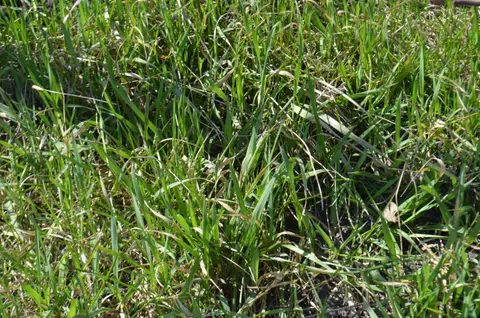
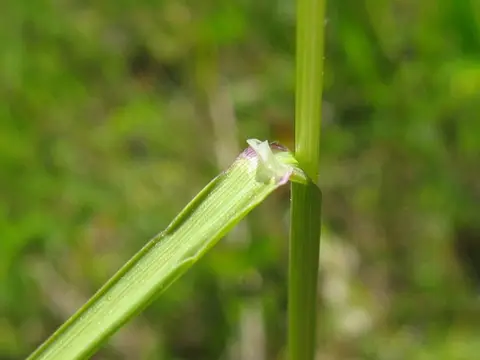
What it actually looks like
Species-level photographs of an established stand, the blade and canopy up close, and — where one exists — the off-season colour.
Four honest reasons to choose something else
Kentucky bluegrass is the northern lawn people aspire to, and it is oversold to yards that can't feed its appetite for sun and water. Every one of these is a common, expensive mismatch.
This is a sun grass — it wants six or more hours of direct sun, and it thins fast under trees or a north wall no matter how you feed it. A few improved cultivars stretch that a little, but shade is its hard ceiling, not a challenge to manage.
Bluegrass goes tan and dormant in a hot, dry summer and needs roughly an inch to an inch and a half of water a week to stay green. If you want a lawn that shrugs off drought without a hose, its shallow roots aren't built for it.
It germinates in two to three weeks — slower than any other cool-season lawn grass — and takes a full season to knit into real sod. If you need cover in a hurry or missed the fall window, this is the slowest way to get there.
At the warm edge of its range, brutal summers push bluegrass into dormancy and invite summer patch. Deep-rooted tall fescue holds green through that heat with far less water and disease trouble.
Mow it tall, and raise it higher in summer
Kentucky bluegrass looks its best mowed on the taller side — most home lawns sit between 2.5 and 3 inches, and it tolerates anywhere from about 2 up to 3.5. Taller turf shades the soil, roots deeper, and out-competes weeds, all of which matters more for bluegrass than for a low-cut warm-season grass. It will take a shorter cut than tall fescue, but there is no reward for it on a home lawn.
Raise the deck as summer heat arrives. Height is bluegrass's cheapest defense against the two things that hurt it most — heat stress and summer patch — so let it run toward 3 to 3.5 inches through July and August. A lawn scalped short in midsummer is a lawn asking to brown out and get sick.
Follow the one-third rule and keep the blade sharp. In the spring and fall flushes you'll mow about weekly; through the summer slowdown you'll mow far less, and if the lawn has gone dormant you stop mowing it entirely until it greens back up. Because bluegrass self-repairs, it forgives the occasional missed week better than a bunch-type grass does — the rhizomes fill back in.
The hungriest cool-season grass, fed mostly in fall
Kentucky bluegrass has the biggest appetite of the common cool-season grasses — plan on roughly 2 to 4 pounds of nitrogen per 1,000 square feet per year, more than tall fescue or fine fescue want. That appetite is the price of its density and its self-repair: the rhizomes and the thick sod they build need fuel. It's also why bluegrass tends to build thatch faster than other lawn grasses, so don't overshoot the top of that range.
Timing is the opposite of a warm-season lawn's. The bulk of the nitrogen goes down in fall, when the grass is storing energy for winter and building roots — a feeding around Labor Day and another in mid-to-late fall does more for next year's lawn than anything you apply in spring. Go light in spring, and back off almost entirely in summer: nitrogen pushed into hot weather feeds summer patch and burns a stressed lawn. Spoon-feed in half-pound increments rather than dumping it.
The full seasonal schedule, with soil-temperature triggers and the fall-weighted split, lives in the cool-season calendar. Get a soil test before buying anything with phosphorus or potassium in it — a fall-loaded nitrogen program is usually all a healthy bluegrass lawn asks for.
Seed it in fall, and give it time
Kentucky bluegrass is grown from seed, and its slow start is the real drawback to know going in. It germinates in about two to three weeks — the slowest of the cool-season lawn grasses, several times slower than perennial ryegrass — and then takes the rest of the season to spread by rhizome into the dense sod it's known for. There is no shortcut around the calendar here; there is only picking the right window.
That window is late summer into early fall. Extension programs across the north — Nebraska, Purdue, Penn State — put the prime seeding date in the August-15-to-September-15 range, because seeding into warm soil with cooling air and light weed pressure maximizes the time a young stand has to root before it ever faces a summer. Spring seeding is possible but a distant second: the seedlings collide with crabgrass and summer heat before they're strong enough to take it.
The normal route. Sow about 2–3 lb per 1,000 sq ft into a firm, clean seedbed in early fall and keep the surface consistently moist — bluegrass is slow to germinate and unforgiving of drying out during those first weeks. Expect a full season before it knits into real sod.
Bluegrass is often sold blended with a little perennial ryegrass, which sprouts in days and holds the soil while the slower bluegrass fills in behind it. A common, sensible way to buy speed without giving up the self-repair that makes bluegrass worth planting.
Nearly all cool-season sod is Kentucky bluegrass, precisely because its rhizomes bind soil into a mat that lifts and transplants cleanly. The fast, expensive route to an instant lawn — and the only one that skips the long germination wait.
Do not apply a pre-emergent crabgrass herbicide to an area you're about to seed — the barrier that stops crabgrass stops bluegrass from germinating just as effectively. And because germination is slow, the seedbed has to stay damp for weeks, not days; light, frequent watering until the stand is up is the single biggest factor in whether it takes.
Full sun and water, or nothing
Sun is the first thing to be honest about. Kentucky bluegrass is a full-sun grass — it wants six or more hours of direct sun, and its shade tolerance is only fair even among the cool-season grasses, well behind fine fescue and tall fescue. Improved cultivars buy a little margin, but under mature trees or a north-facing wall it thins out and weeds move in, and no fertility or watering program reverses that. If your yard is shady, this is the wrong grass, full stop.
Water is the second. Bluegrass is shallower-rooted than tall fescue and leans on about an inch to an inch and a half of water a week, delivered in one or two deep soakings, to hold color through summer. Give it that and it stays green; withhold it and it goes summer-dormant — tan, but alive, and it greens back up when rain and cooler weather return. What you can't do is dribble water at a stressed lawn; deep-and-infrequent beats daily sprinkles every time.
Cold and recovery are where bluegrass simply wins. It is the most cold-hardy lawn grass here, thriving up into zone 3 where other lawns thin or winterkill, and its rhizomes give it the best self-repair of any cool-season grass — divots, worn paths, and torn spots fill back in on their own. That single trait, recovery by rhizome, is the whole reason to plant it and the thing no bunch-type grass can match.
Summer patch is the one that defines it
Kentucky bluegrass is a healthy, resilient grass most of the year, but it is prone to a handful of diseases that hit in summer heat and humidity — and the worst of them, the root-rot patch diseases, are set up by mistakes made months earlier. Mow tall, water deep and infrequently, ease off summer nitrogen, and keep thatch down, and cultural practice heads off most of what follows.
The signature bluegrass disease. A root-infecting fungus that attacks in spring when soils reach the mid-60s but shows up as circular, straw-colored patches — often with a green tuft of survivors in the middle, the classic 'frog-eye' — during summer heat and drought stress. Favored by close mowing, overwatering, compaction, thatch over 3/4 inch, and high soil pH. The levers are cultural: raise the height of cut, aerate, water deeply but infrequently, and hold soil pH toward 5.5–6.0.
A close cousin of summer patch that also rots roots and throws the same frog-eye rings, most common on sodded lawns in their second or third year. Same playbook: resistant cultivars through overseeding, core aeration, higher mowing, and steady deep watering do more than any spray.
A Drechslera complex that peppers leaves with dark spots in cool, wet spring weather, then 'melts out' crowns and roots into thinning brown patches. Older common-type bluegrasses are far more susceptible than modern improved cultivars, which is a good reason to buy a named blend. Avoid heavy spring nitrogen, which feeds it.
Small, silver-dollar-sized bleached spots, worst on lawns short on nitrogen and holding dew overnight. Often the fix is fertility and morning watering rather than fungicide.
The through-line is that bluegrass diseases are managed by how you mow, water, and feed far more than by chemistry. Right height of cut, morning irrigation, no heavy summer nitrogen, and keeping thatch in check prevent most of it. Fungicide timing, where it's warranted, is covered in the cool-season calendar.
It browns out in summer, not winter
The brown season for Kentucky bluegrass is July and August, not January — this is a cool-season grass, and it's summer heat and drought that shut it down, the mirror image of a warm-season lawn. When soil dries out and temperatures climb past the mid-70s, bluegrass conserves itself: it stops growing, goes off-color to tan, and waits. The rhizomes and crowns stay alive underground even when the blades look dead. It's a survival mechanism, not damage, and a healthy stand can hold dormant for several weeks and green back up when rain and cooler weather return.
The decision each summer is whether to water it green or let it sleep. Either is fine — what hurts the lawn is flip-flopping. Commit to about an inch to an inch and a half of water a week and it stays green; or let it go dormant and give it just enough water, roughly a half inch every couple of weeks, to keep the crowns alive without waking it up. What you shouldn't do is repeatedly half-water a dormant lawn, which breaks and re-breaks dormancy and drains the reserves it's living on.
Winter is the easy season for this grass. As the most cold-hardy lawn here, bluegrass simply hardens off and holds through the cold — semi-dormant and off-color, sometimes straw-tinged after a hard freeze, but rarely killed. It greens up early and reliably in spring, well ahead of any warm-season lawn, and comes out of winter in far better shape than it comes out of a droughty summer. If you're going to lose bluegrass, you'll lose it to July, not January.
Kentucky bluegrass vs. tall fescue vs. perennial ryegrass
The three cool-season grasses most northern lawns are actually choosing between. The short version: bluegrass for a dense, self-repairing sun lawn, tall fescue for heat and drought toughness, perennial ryegrass for fast germination and wear.
| Trait | Kentucky bluegrass | Tall fescue | Perennial ryegrass |
|---|---|---|---|
| Shade tolerance | Fair | Good | Fair |
| Traffic and recovery | Good, self-repairs | Good wear, bunch-type | Excellent wear |
| Nitrogen appetite | 2–4 lb N/M | 2–4 lb N/M | 2–4 lb N/M |
| Mowing height | 2–3.5 in | 2.5–4 in | 1.5–2.5 in |
| Mowing frequency | Moderate | Moderate | Moderate–high |
| Texture | Fine to medium | Medium-coarse | Fine to medium |
| Establishment speed | Seed, slow | Seed, fast | Seed, fastest |
| Main disease | Summer patch / dollar spot | Brown patch | Gray leaf spot / red thread |
| Spread & self-repair | Spreads by rhizomes | Bunch-type (no spread) | Bunch-type (no spread) |
Keep reading
This page covers the grass. The guides cover the calendar — when to do each thing, and what triggers it.
Photography credits
- Ethan2039 — CC BY-SA 4.0 (opens in a new tab) · Source (opens in a new tab)
- Kristian Peters (User:Fabelfroh) — CC BY-SA 3.0 (opens in a new tab) · Source (opens in a new tab)
Sources
Every agronomic claim on this page traces to a named university extension or USDA publication. Regional programs sometimes disagree; where they do, we say so rather than averaging them.
Educational and regional in nature. Always follow the label on any product you apply — the label is the law, and it supersedes any general guidance here.
You know the grass. Now get the schedule.
Tell LawnDominator you have Kentucky bluegrass and it builds the program around it — the fall-weighted nitrogen split, the summer-patch height and watering rules, the early-fall seeding window, and the one thing to do this week. 14 days free, no credit card.