St. Augustinegrass
The warm-season shade grass. If you have a hot, humid Gulf Coast or Deep South yard with trees, nothing common holds up under filtered shade like St. Augustine — coarse, blue-green, and lush enough to carpet a spot where bermuda would surrender. That look comes with a short list of real costs. It is the least cold-hardy lawn grass here, so a hard transition-zone winter can kill it outright. It takes wear badly and can't be seeded — you buy it as sod or plugs. And it is a magnet for chinch bugs, the one pest that will cook a St. Augustine lawn brown in a summer week. If you're south enough to keep it alive and you want shade tolerance above all, this is the grass. If you need a lawn that takes traffic, survives cold, or goes in from a seed bag, keep reading — this isn't the one.
What St. Augustine tolerates, and what it doesn't
Ratings are relative to other lawn grasses, not absolute. St. Augustine's profile is lopsided by design: it is the shade champion of the warm-season grasses and thrives in Gulf Coast heat, but it pays for that with the worst cold tolerance and poor wear tolerance of the common lawn grasses.
Not all St. Augustine is Floratam
St. Augustine has no true seed — every named cultivar is established from sod or plugs, so the variety is set at the sod farm, not the seed bag. That makes the choice worth getting right, because the cultivars are not interchangeable. They split on the axes that actually matter for this grass: how much shade they take, how cold-hardy they are, how coarse the blade is, and how well they hold up to chinch bugs. Floratam is the default you'll be offered across the South, but it is also the most cold-tender and the least shade-tolerant of the group — the opposite of what a lot of buyers actually need. Here are the ones a homeowner is most likely to see, and what each is really for.
The industry standard and the one most sod farms grow by default. A big, vigorous, coarse-bladed grass released by Florida and Texas A&M, bred originally for resistance to chinch bugs and St. Augustine Decline (SAD) virus. The catch: chinch bug populations have since overcome that resistance in much of Florida, and Floratam is both the most cold-tender and the least shade-tolerant type here — it wants a full six hours of sun and dies back hard in a transition-zone freeze.
The popular homeowner alternative to Floratam, and usually the better pick for a real yard. Finer, softer, more emerald blade, noticeably more shade-tolerant, and more cold-hardy — so it holds up better under trees and further north than Floratam does. If you have filtered shade or you're near the cool edge of St. Augustine country, this is the one to ask the farm for by name.
The cold-tolerance specialist, developed at NC State and the common choice through the upper South and the cooler edge of the range where Floratam won't survive winter. Coarse-bladed and SAD-resistant, but the tradeoffs are real: limited shade tolerance, a slow spring green-up on cold soils, and a reputation for being disease-prone — especially large patch. You choose Raleigh for one reason, and that reason is winter.
A semi-dwarf, low-growing cultivar with a fine blue-green blade and good shade tolerance — one of the types (along with Floratine) reached for when the spot is shady and a lower, denser look is wanted. The dwarf habit means a lower canopy and less mowing, but it comes soft: weaker cold tolerance and more susceptibility to disease and chinch bugs in humid weather. A shade-and-looks choice, not a durability one.
The newest thing on the list — a Scotts-developed cultivar engineered to tolerate glyphosate, so you can spray Roundup over the top to kill weeds without harming the lawn. It's also naturally low- and slow-growing, which cuts mowing by roughly half. Sold as sod only, at a premium, and its genetically modified status means it isn't available everywhere. A convenience play for the homeowner who wants easy weed control and less mowing.
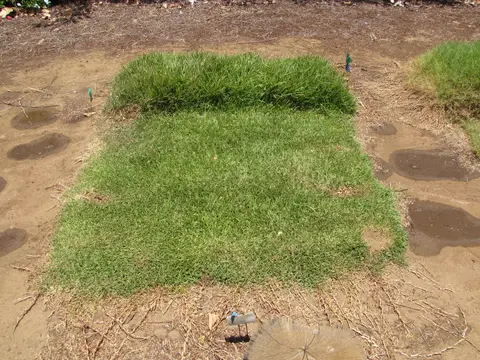
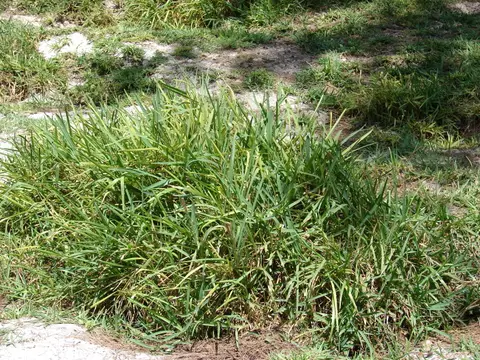
What it actually looks like
Species-level photographs of an established stand, the blade and canopy up close, and — where one exists — the off-season colour.
Four honest reasons to choose something else
St. Augustine is the right answer for a shady Gulf Coast yard and the wrong answer for a lot of others. Each of these is a common, expensive mistake.
This is the most cold-tender lawn grass here. Above zone 8 — or on an exposed cold edge inside it — a hard freeze can kill it to the ground, not just brown it. Cold survival is exactly where zoysia beats it.
Kids, dogs, a worn path, anything with wheels — St. Augustine has poor wear tolerance and ruts on wet soil. It spreads to fill gaps but can't take repeated abuse. Fast, tough recovery is bermuda's job.
There is no true seed for the named cultivars like Floratam — you establish it from sod, plugs, or sprigs only. Sod is fast but expensive; plugs are cheap but slow. If a seed bag is the plan, this grass rules itself out.
It is a chinch-bug magnet in hot, sunny spots, it builds thatch, and it wants more water and mowing than the low-input grasses. It rewards attention and punishes neglect.
Mow it tall — taller than anything else here
St. Augustine is the tallest-cut common lawn grass. Keep it between 2.5 and 4 inches through the growing season, and lean to the high end — 3 to 4 inches — anywhere it is shaded. Height is not cosmetic here: the extra leaf area is how a shade grass gathers enough light to survive under trees, and a taller canopy shades out weeds that a short lawn would let in. The one time to drop lower is a single early-spring cut around 2 to 2.5 inches to clear dead winter tissue before green-up.
The blades are coarse and wide — this is the roughest-textured grass on the warm-season list, and there's no fixing that with maintenance. That coarse, tough tissue dulls a mower blade fast, so sharpen monthly and cut only when the grass is dry. A dull blade shreds the wide leaves and leaves a whitish, frayed cast across the lawn.
Follow the one-third rule and don't let it get ahead of you. St. Augustine spreads by thick aboveground runners and builds thatch faster than most lawns; if that spongy layer passes about half an inch it holds disease and pests and needs to come out. Mowing on schedule at the right height is most of thatch control — details and the full-season plan are in the warm-season calendar.
A moderate appetite, tuned to your latitude
St. Augustine wants roughly 2 to 4 pounds of nitrogen per 1,000 square feet per season, and where you are in that range depends on how far south you are and what your soil is. Heavier clay and north-of-the-line lawns sit near 2; sandy Deep South and South Florida lawns run toward 4 or more because sand holds nothing. Apply it in half- to one-pound doses spaced weeks apart while the grass is actively growing — never more than a pound of quick-release N at once.
Timing beats total. Start only after the lawn has fully greened up and you've mowed it a couple of times — not at the first warm spell — and put the last feeding down about six weeks before your average first frost. Nitrogen dumped on early or late does two harmful things at once: it feeds large patch, and it pushes soft growth that chinch bugs and cold both punish. A lush over-fed St. Augustine lawn is a more fragile one.
Get a soil test before buying anything with phosphorus or potassium in it, and set the per-zone schedule with the soil-temperature triggers in the warm-season calendar.
No seed — you buy this lawn as sod or plugs
Here is the fact that decides the budget: the named St. Augustine cultivars — Floratam, Palmetto, CitraBlue, Raleigh and the rest — are established by vegetative propagation only. There is no commercial seed. You plant sod, plugs, or sprigs, and that's it. Plant in late spring through early summer once soil is reliably warm, so the runners have the whole season to knit together and root before the first freeze. Whatever method you pick, keep the area weed-free while the stolons spread and close in.
The fast, expensive, and by far most common route. Rolls of mature turf give instant cover and shut out weeds immediately. Buy from a farm that names the cultivar so you know the cold and chinch-bug tolerance you're getting, and lay it before fall so it roots ahead of winter.
Small squares set on 12-inch centers that spread by runners to fill in over a couple of months in warm weather. Much cheaper than sod, but you are watering and weeding the open ground between plugs the whole time they close.
Chopped stolons broadcast and pressed into moist soil. The cheapest material but the fussiest — sprigs dry out fast and need constant moisture to take. Rarely worth it for a home lawn versus plugs.
Do not put down pre-emergent herbicide on ground you are about to plug or sprig — the barrier that stops crabgrass stops St. Augustine runners from rooting just as well. Because there is no seed fallback, starting with clean, weed-free soil and staying on top of weeds during fill-in is the whole game.
Shade is what it's for; cold is what kills it
Shade tolerance is the entire case for St. Augustine. It is the most shade-tolerant warm-season grass — it will hold under filtered light and beside a tree line where bermuda thins to dirt. That tolerance has a floor, though: it still needs about four to six hours of sun or good dappled light to survive, and dense, all-day shade eventually starves it too. Cultivar matters here — Floratam is the least shade-tolerant and wants a full six hours, while types like Palmetto and Seville take more shade. Afternoon light beats morning light.
Cold is the hard boundary in the other direction. This is the least cold-hardy lawn grass in common use, dependable only in zones 8 through 11. Winter freezes turn it brown like any warm-season grass, but at the cold edge a hard freeze doesn't just brown it — it can kill the stand outright, and cold tolerance varies a lot by cultivar. If you're anywhere near the transition zone, this is the single biggest risk you're taking.
On water it is thirstier than its warm-season peers — about three-quarters to an inch a week during active growth, delivered deep and infrequent in the early morning. It does bring one quiet strength: relatively good salt tolerance, which is part of why it dominates coastal Southern lawns. Traffic is its weak spot — poor wear tolerance and easy rutting on wet ground — so keep play and paths off it or expect thin, worn tracks.
Chinch bugs first, then a short list of diseases
St. Augustine has one defining pest and a handful of diseases that ride on the same mistakes — too much nitrogen, too much water, too much thatch. The pest is the one to internalize: the southern chinch bug is to St. Augustine what large patch is to zoysia. It is the reason a lush lawn can go brown in a week of July heat.
The signature St. Augustine pest, by a wide margin. It sucks sap and injects toxin, producing spreading irregular patches of yellow-to-dead grass in the hottest, sunniest parts of the lawn — damage that's easy to mistake for drought. Confirm with the coffee-can float test and treat around a threshold near 25 bugs per square foot. Floratam was bred for chinch-bug resistance, but populations have since overcome it, so cultivar choice helps only so much.
The main St. Augustine disease. Tan-to-gray oblong lesions with purple-brown margins on the blades in warm, humid, wet weather, worst on lawns pushed with nitrogen. Cultural control — balanced feeding and deep, infrequent morning watering — usually handles it on a home lawn.
Rhizoctonia, the same fungus that plagues zoysia. Circular yellow-to-orange-bordered patches in spring and fall when soil is 50–70 °F; diseased shoots pull free easily from the runner. Driven by late-season nitrogen, overwatering, and thatch. Fix drainage and time a preventative fungicide to the soil-temperature window.
A soil-borne root disease that thins and yellows the lawn while the roots turn short, dark, and rotten, worst under stress and alkaline soil above pH 7. There's no quick chemical cure — manage drainage, ease off nitrogen, and acidify with peat or sulfur.
St. Augustine Decline — a mosaic virus that yellow-mottles the blades and slowly weakens the stand. Historic cultivars like Floratam and Raleigh were selected partly for resistance, so it's a smaller threat now, but it's why buying a named, resistant cultivar matters.
Culture does more than chemistry for nearly all of it: mow tall, don't overfeed, water deep and in the morning, and keep thatch down. Scout for chinch bugs weekly through the summer — catching them early is the difference between a spot treatment and a dead lawn. Insect and fungicide timing is in the warm-season calendar.
Brown in winter — and sometimes gone
St. Augustine browns off with the first fall freezes and stays off-color until soil warms in spring, the same broad pattern as every warm-season grass. Depending on latitude that's three to five months of a tan lawn, and green-up can be slow. None of that, by itself, is damage.
What sets St. Augustine apart is that dormancy here can shade into death. It is the most cold-tender lawn grass, so at the cold edge of its range a hard freeze can kill runners and crowns outright — and you won't know until spring, when the dead areas simply never green back up. Fall management is your insurance: stop nitrogen about six weeks before first frost so the lawn hardens off instead of going into winter soft and lush, keep it watered through dry winter spells, and don't scalp it going into the cold.
Overseeding with winter ryegrass for temporary green is possible but competes with the lawn at spring green-up, and most extension programs don't recommend it for a home St. Augustine lawn. If you're regularly seeing winterkill, the honest read is that you're too far north for this grass — that's a zone problem, not a care problem.
St. Augustine vs. zoysia vs. bermuda
The three warm-season options most Southern lawns are choosing between. The short version: St. Augustine for shade, zoysia for a dense low-input compromise, bermuda for sun and traffic. Pick St. Augustine when shade is the problem — and only if your winters are mild.
| Trait | St. Augustine | Zoysiagrass | Bermudagrass |
|---|---|---|---|
| Shade tolerance | Best of the three | Moderate | Very poor |
| Traffic and recovery | Fair, poor wear | Good wear, slow to heal | Excellent, fastest |
| Nitrogen appetite | 2–4 lb N/M | 2–3 lb N/M | 3–6 lb N/M |
| Mowing height | 2.5–4 in | 0.5–2 in | 0.5–1.5 in |
| Mowing frequency | Moderate | Moderate | Highest |
| Texture | Coarse | Fine to medium | Fine (hybrids) |
| Establishment speed | Sod/plugs, moderate | Slowest | Fast |
| Main disease | Grey leaf spot | Large patch | Spring dead spot |
| Spreads into beds | Moderately | Slowly | Aggressively |
Keep reading
This page covers the grass. The guides cover the calendar — when to do each thing, and what triggers it.
Photography credits
- Forest & Kim Starr — CC BY 3.0 US (opens in a new tab) · Source (opens in a new tab)
- Forest & Kim Starr — CC BY 3.0 (opens in a new tab) · Source (opens in a new tab)
Sources
Every agronomic claim on this page traces to a named university extension or USDA publication. Regional programs sometimes disagree; where they do, we say so rather than averaging them.
Educational and regional in nature. Always follow the label on any product you apply — the label is the law, and it supersedes any general guidance here.
You know the grass. Now get the schedule.
Tell LawnDominator you have St. Augustine and it builds the program around it — nitrogen rate per zone, the summer chinch-bug watch, the large-patch window, soil-temperature triggers, and the one thing to do this week. 14 days free, no credit card.