Centipedegrass
The lazy man's grass — the lowest-input lawn grass in the South, and proud of it. Centipede is a slow, apple-green carpet built for the acid, sandy soils of the Southeast Coastal Plain, and it asks for less of everything than bermuda or St. Augustine: less mowing, and far less nitrogen. That last part is the whole game. Centipede's natural color is a light 'Granny Smith' green, not deep emerald, and every attempt to force it darker with more fertilizer, more lime, and more water pushes it toward the disorder that kills it — centipede decline. Treat it like a low-maintenance lawn and it thrives on neglect. Treat it like bermuda and you will fertilize it to death. If you want a plush, dark, hard-wearing lawn you can push hard, keep reading — this isn't the one.
What centipede tolerates, and what it doesn't
Ratings are relative to other lawn grasses, not absolute. Centipede's profile is lopsided on purpose: it trades toughness, cold hardiness, and rich color for the lowest maintenance of any Southern lawn. Read it as a specialist for low-input yards on acid soil, not an all-rounder.
A short cultivar list, and that's fine
Centipede is the opposite of bermuda here: where bermuda has dozens of cultivars and the choice genuinely changes what you get, centipede has a handful and the differences are modest. Cold hardiness is the one trait worth choosing for at the northern edge of the range; texture and color barely move between them. In practice almost everyone plants one of the first two on this list — common because it's cheap seed, TifBlair because it's the improved seed. The vegetative selections are real, but they're a sod-farm and specialty decision, not something most homeowners need to weigh.
The default, and the one most seeded lawns actually are. An undeveloped, seed-grown population with centipede's classic light apple-green color and slow, prostrate habit. Cheapest way in, and perfectly fine for most yards — its only real weakness is being the least cold-hardy of the group, which matters only at the northern edge of the range.
The improved seeded standard, released by the University of Georgia in 1997 and selected for better cold and freeze tolerance — the reason to spend up from common if you're near zone 7. Available as both seed and sod, with a slightly faster growth rate than other centipedes. If you want an improved cultivar without leaving seed behind, this is the one.
A proprietary vegetative selection (Sod Solutions) sold as sod, not seed — representative of the improved sod-only cultivars like Santee and TennTurf. It leans a deeper emerald green and holds fall color a few weeks longer than common. A nice-to-have, not a need-to-have: you're buying it for uniform sod and slightly better color, not a different grass.
What it actually looks like
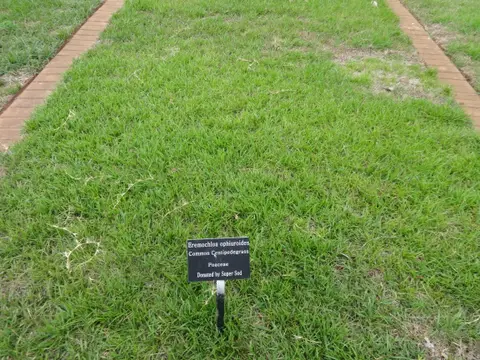
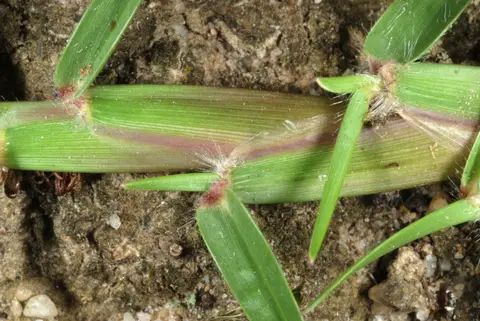
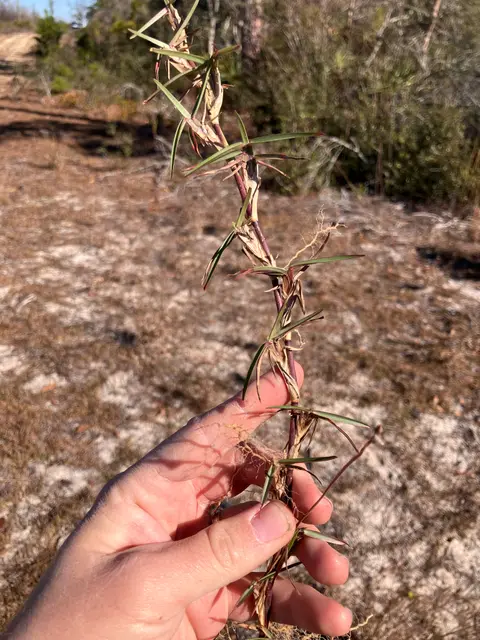
Species-level photographs of an established stand, the blade and canopy up close, and — where one exists — the off-season colour.
Four honest reasons to choose something else
Centipede is the right answer for a specific, common situation: an acid-soil Southern yard whose owner wants the least possible lawn work. Outside that lane it is the wrong grass, and pushing it to perform is the classic, expensive mistake.
Kids, dogs, a worn path to the gate — centipede's loose turf wears thin and heals slowly. It is a look-at, not a play-on, lawn. Wear tolerance is not what this grass is for.
Centipede's natural color is light apple-green, and it stays low and thin. Chasing a thick emerald look with fertilizer is exactly how people kill it. If rich color and density are the goal, this grass will only disappoint you.
Centipede wants acid soil (pH 5.0–6.0) and has poor salt tolerance. On high-pH soil it goes chlorotic and declines; near salt spray or salty irrigation it struggles. Coastal and hard-water yards are a bad match.
Centipede is one of the least cold-hardy lawn grasses, with a northern limit around zone 7. Push it into colder country and winterkill is a matter of when, not if.
Low and infrequent — the easy part
Mowing is where centipede pays you back. It grows slowly and stays low, so most lawns need cutting only every one to two weeks in peak season — less than almost any other Southern grass. Set the mower at 1 to 1.5 inches for a lawn in full sun, and raise it toward 2 inches in areas that get some shade, where a little more leaf helps it hold on.
Keep the blade sharp and follow the one-third rule, removing no more than a third of the leaf height at a cut. A dull blade shreds centipede's medium-textured leaves and leaves a ragged, off-color surface. During drought or heat stress, raising the height a quarter to a half inch takes pressure off the plant.
Resist the urge to scalp it low for a manicured look. Centipede's shallow roots and slow recovery mean a hard scalp thins the stand and invites weeds and decline — the opposite of the low-effort payoff you planted it for.
The one rule: feed it almost nothing
This is the section that decides whether your centipede lives. It has the smallest appetite of any lawn grass — 1 to 2 pounds of nitrogen per 1,000 square feet per year, and UGA's flat advice is that one pound is ample. Split it into small doses: an application in early May after full green-up, and another in late summer, each a half to one pound of N, using a high-potassium formula like 15-0-15 rather than a heavy nitrogen 'lawn food.' Do not feed it in early spring before it has fully greened up, and do not feed it into fall.
More nitrogen does not give you a better lawn — it gives you a dead one. Excess N drives lush dark-green growth, thatch buildup, and reduced cold hardiness, and it is the leading cause of centipede decline. The same goes for lime: centipede wants an acid soil of pH 5.0–6.0, and liming it 'because that's what you do for a lawn' raises pH, locks up iron, and turns it yellow. Never lime centipede without a soil test telling you to.
When it does go pale, the fix is usually iron, not nitrogen. A light spray of ferrous sulfate (about 2 ounces in 3–5 gallons of water per 1,000 square feet) greens it up for a few weeks without pushing growth. Get a soil test before adding anything, and let the warm-season calendar handle the timing so you don't over-do it.
Cheap to start, but slow to cover
Centipede is one of the few premium warm-season lawns you can start from seed, which makes it cheap to establish — but patience is the price. It roots and spreads slowly, so whatever method you choose, the first year or two is mostly about keeping the area clean and watered while it knits together. Plant into warm soil in late spring or early summer, and get a soil test first so you start at the right, acid pH.
The budget route and centipede's real advantage over St. Augustine. Sow just 1/4 to 1/2 pound per 1,000 square feet into warm soil; the tiny seed germinates in about a month. Cheap, but slow — a seeded lawn can take up to three years to become uniform and dense, and weeds will exploit the gaps until it closes.
The fast, weed-free way to a full centipede lawn, at a much higher price than seed. Lay it into warm soil and keep it watered until rooted before winter. The obvious choice if you can't spend two or three seasons nursing seed to cover.
Do not apply pre-emergent herbicide to an area you're about to seed — the barrier that stops crabgrass stops centipede from rooting just as well. Because fill-in is so slow, weed pressure during establishment is the real fight; start with a clean seedbed and stay on it.
Acid, sandy, sunny — and don't ask for more
Centipede is a specialist for the acid, sandy soils of the Southeast Coastal Plain and lower Piedmont. It actually prefers a low soil pH of 5.0 to 6.0, where the iron it needs stays available; on neutral or alkaline soil it goes chlorotic and slides into decline. That single preference — most lawns want it near neutral, centipede wants it acid — is what makes it thrive where other grasses sulk, and fail where you'd expect a lawn to be easy.
It wants full sun, or close to it — six hours or more. Shade tolerance is only fair: better than bermuda, nowhere near St. Augustine, and it thins under dense, all-day shade. Water demand is modest, about an inch a week during active growth in deep, infrequent soakings, but its shallow root system means it wilts and browns sooner than bermuda when a drought sets in.
The hard limits are cold, traffic, and salt. It is one of the least cold-hardy lawn grasses, with a practical northern edge around zone 7 and real winterkill risk beyond it. Its loose turf does not take wear, so it's wrong for play areas and paths. And its poor salt tolerance rules out coastal spray zones and salty irrigation. Match those conditions and centipede is nearly carefree; fight them and no amount of care saves it.
Decline is the real disease — and you cause it
Centipede's headline problem is not a fungus or a bug; it's a self-inflicted disorder called centipede decline, and the cause is almost always too much help. The pests below matter, but the thing most likely to kill your lawn is a fertilizer spreader and a bag of lime.
The signature disorder. The grass either fails to green up in spring or greens up and then dies back in late spring and summer. It is the cumulative result of over-fertilizing with nitrogen, high soil pH (usually from liming), thatch buildup, iron deficiency, and mowing too low — all the ways people 'take care of' a lawn that centipede does not want. The cure is prevention: minimal nitrogen, acid pH, no unneeded lime, thatch control, and iron instead of feed when it pales.
A Rhizoctonia disease that shows up as circular brown patches, worst in cool, wet weather in fall and spring — and made worse by excess nitrogen and thatch. Manage it culturally first: hold nitrogen down, water in the morning, and keep thatch in check. Fungicides are a fall play, not a spring rescue.
Soil-dwelling scale insects that attach to roots, causing irregular yellow-to-dead patches that slowly enlarge. Centipede is highly susceptible, and there is no reliable chemical control — a well-managed, unstressed lawn is the only real defense.
Microscopic root parasites, especially ring nematodes, that thin and weaken centipede on sandy soils and mimic drought or nutrient stress. A soil assay confirms them; management is about keeping the lawn as unstressed as possible, since curative options for home lawns are limited.
Notice the pattern: nearly every problem is fed by the same three things — too much nitrogen, high pH, and thatch. Get those right and centipede is one of the lowest-trouble lawns you can own. Timing for the fall disease window lives in the warm-season calendar.
Brown in winter, and slow to trust the spring
Like every warm-season grass, centipede goes dormant and tan after the first hard frost and stays that way until soil temperatures climb in spring — roughly three to four months of a brown lawn, depending on how far south you are. None of it is damage, and there is nothing to fix.
The trap is spring. Centipede greens up on the slow side, and its worst enemy is an owner who tries to hurry it with early nitrogen. Feeding before it has fully greened up is a direct cause of centipede decline and poor spring recovery — extension guidance is to wait until the grass is fully green and soil at the four-inch depth is consistently around 65 °F before the first feeding. Impatience here is how a healthy lawn dies in April.
Skip winter overseeding, too. Ryegrass over dormant centipede competes with it exactly as the slow, low-vigor turf is trying to emerge, and centipede rarely wins that fight. The honest move is to accept the brown season, keep off the dormant turf, and let it wake on its own schedule.
Centipede vs. St. Augustine vs. bermuda
The Southern trade-off in one table. The short version: centipede for the least possible work on acid soil, St. Augustine for shade, bermuda for a lush lawn you can push hard and walk on.
| Trait | Centipedegrass | St. Augustine | Bermudagrass |
|---|---|---|---|
| Shade tolerance | Moderate | Best of the three | Very poor |
| Traffic and recovery | Poor | Fair, poor wear | Excellent, fastest |
| Nitrogen appetite | 1–2 lb N/M | 2–4 lb N/M | 3–6 lb N/M |
| Mowing height | 1–2 in | 2.5–4 in | 0.5–1.5 in |
| Mowing frequency | Low | Moderate | Highest |
| Texture | Medium-coarse | Coarse | Fine (hybrids) |
| Establishment speed | Slow | Sod/plugs, moderate | Fast |
| Main disease | Centipede decline / large patch | Grey leaf spot | Spring dead spot |
| Spreads into beds | Slowly | Moderately | Aggressively |
Keep reading
This page covers the grass. The guides cover the calendar — when to do each thing, and what triggers it.
Photography credits
- Michael Rivera (User:Mjrmtg) — CC BY-SA 4.0 (opens in a new tab) · Source (opens in a new tab)
- Douglas Goldman (User:DouglasGoldman) — CC BY-SA 4.0 (opens in a new tab) · Source (opens in a new tab)
- Sterling Herron (saherron) — CC0 (opens in a new tab) · Source (opens in a new tab)
Sources
Every agronomic claim on this page traces to a named university extension or USDA publication. Regional programs sometimes disagree; where they do, we say so rather than averaging them.
Educational and regional in nature. Always follow the label on any product you apply — the label is the law, and it supersedes any general guidance here.
You know the grass. Now get the schedule.
Tell LawnDominator you have centipede and it builds the program around it — the one-pound nitrogen budget, the acid-pH target, the iron-instead-of-feed rule, and the one thing to do this week without pushing it toward decline. 14 days free, no credit card.