Tall fescue
The low-drama transition-zone workhorse. Turf-type tall fescue sends roots deeper than any other cool-season grass, and that one trait carries the whole plant: it holds up in part shade, shrugs off heat that browns out bluegrass, and stays green through more of the summer than anything else in its class. It asks for less coddling than Kentucky bluegrass and less water than most people expect. The catch is that it grows in bunches — it has no rhizomes to speak of, so it does not creep to fill a gap. When wear or a bad summer thins it, the fix is a bag of seed in the fall, not patience. If you want a tough, honest lawn for the middle of the country and you are willing to overseed to keep it thick, this is the one. If you want a fine carpet that heals its own bare spots, keep reading — that's bluegrass, not fescue.
What tall fescue tolerates, and what it doesn't
Ratings are relative to other lawn grasses, not absolute. Tall fescue's profile is the most heat- and drought-durable of the cool-season grasses — the deep root system does most of the work — with one built-in limit: it grows in bunches, so it recovers only as fast as you reseed it.
Buy a blend, not Kentucky-31
Tall fescue is the species where obsessing over a single named cultivar is a mistake. Almost nobody should — and almost nobody does — buy one elite variety by name. The improved turf-types are sold, and are meant to be planted, as blends of several top cultivars, because no single one wins on every trait and a blend spreads the risk. The one real decision you have to get right is at the coarse end: modern turf-type blends versus the old forage-type Kentucky-31 still sitting on the cheap end of the shelf. Get that right and read the seed tag, and the specific cultivar names barely matter.
This is what to buy. 'Turf-type' tall fescue has been bred for decades to be finer, darker, and far denser than the old forage grass, and it is sold as a blend of several elite cultivars rather than one. The blend is the point: mixing top performers hedges against any one variety's weak spot, brown patch included. Look for a bag whose tag names two or more improved cultivars — extension trials suggest at least half the seed should be high-performing named varieties, the more the better.
The one to avoid for a lawn. K-31 is a forage- and pasture-type tall fescue — coarse-bladed, light green, upright, and low-density — that predates the turf breeding entirely. It is cheap and everywhere, which is exactly why people plant it by accident. In university field trials it lands at the bottom for density and quality. Fine for a hay field or an erosion bank; the wrong grass for the lawn you actually want to look at.
A turf-type blend with a small percentage of Kentucky bluegrass folded in — often around 5 to 10 percent by weight. The bluegrass adds the one thing tall fescue can't do for itself: it spreads by rhizomes, so it slowly knits closed the thin and worn spots a pure bunch-type stand leaves open. It won't turn fescue into a self-healing lawn, but it takes the edge off the annual overseeding. A sound choice in the cooler, well-watered part of the range.
Marketed as tall fescue that repairs itself through short rhizomes — the trait ordinary turf-types lack. There is something to it, but temper the pitch: extension specialists note the spread is limited and the drought and self-repair claims run ahead of the independent, peer-reviewed data. Treat it as a normal turf-type blend that may knit a little better, not as a substitute for fall overseeding.
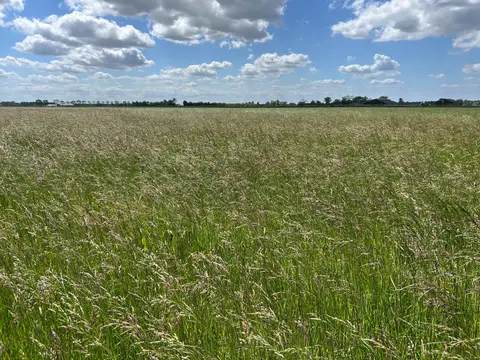
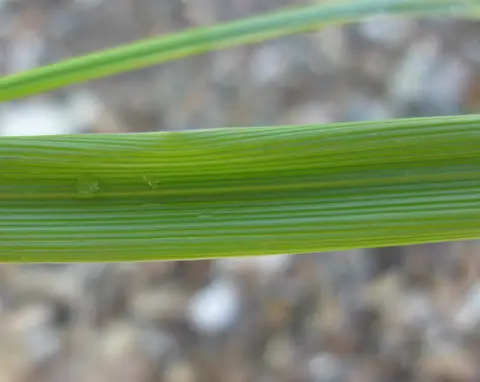
What it actually looks like
Species-level photographs of an established stand, the blade and canopy up close, and — where one exists — the off-season colour.
Four honest reasons to choose something else
Tall fescue is a genuinely great lawn for the middle of the country, but it is the wrong tool for a few specific jobs. Every one of these is a common, avoidable mismatch.
Tall fescue grows in bunches and has no rhizomes to creep sideways, so a worn path, a dog run, or a thinned patch will not close on its own. You fix it with a bag of seed every fall, indefinitely. If you want self-healing turf, that's a rhizomatous grass.
Even the modern turf-types are medium-coarse — noticeably wider-bladed than bluegrass, ryegrass, or fine fescue. It makes a handsome, uniform stand on its own, but it never reads as a fine golf-course carpet, and it looks out of place patched into a fine-textured lawn.
Tall fescue is hardy through the transition zone, but it is less winter-hardy than bluegrass and can thin or winterkill in the coldest, most exposed sites at the top of its range. If brutal winters are your defining problem, hardiness is bluegrass's job.
Tall fescue takes part shade better than most lawn grasses, but under mature trees or a north wall with only an hour or two of sun it thins like everything else. Part shade is its ceiling, not deep shade.
Cut it tall — the height is the drought plan
Tall fescue wants to be mowed high. Keep it between 2.5 and 4 inches, with most home lawns sitting right around 3 inches through spring and fall, and raise the deck to 3.5 or 4 inches once summer heat sets in. This isn't cosmetic: a taller canopy shades the soil, keeps roots cooler, and pushes them deeper — and deep roots are the entire reason this grass outlasts bluegrass in a dry August. Scalping it short in July does the opposite and invites both drought stress and brown patch.
The blades are coarse and tough, so keep the mower sharp — a dull blade shreds the wide leaf tips and leaves a whitish, frayed cast across the lawn. Follow the one-third rule and mow often enough in the spring flush that you're never taking off more than a third of the height at once.
One thing mowing will not do here is change how the lawn spreads, because it doesn't spread. Tall fescue is bunch-type: every plant holds its own ground and fills gaps only from seed. Mow it well and it stays dense and even, but the thickening you'd get from a rhizomatous grass has to come from your overseeding, not your mower.
Feed it in the fall — the opposite of instinct
Tall fescue's whole fertility program is weighted to autumn, which trips up people used to feeding lawns in spring. Plan on 2 to 4 pounds of nitrogen per 1,000 square feet a year, and put the bulk of it down in fall: a feeding around September, when a cooling lawn is thickening up and driving roots, and a second in November while it's still green and storing energy. Spring gets a light optional feeding at most; summer gets little to none.
The reason to hold back in the warm months isn't just growth — it's disease. Heavy spring and summer nitrogen pushes lush, soft growth exactly when brown patch is looking for it, so front-loading the year into fall gives you a thicker, deeper-rooted lawn and less trouble in July. Get the fall timing right and you avoid most of what's in the diseases section below.
The full seasonal schedule, with the soil-temperature triggers, lives in the cool-season calendar. Get a soil test before you buy anything with phosphorus or potassium in it — an established tall fescue lawn rarely needs the amounts a bagged 'lawn food' provides.
Seed it in early fall — and keep seeding it
Tall fescue is a seeded grass, and the prime window is late summer into early fall — roughly mid-August through September across most of its range — when soil is still warm enough for fast germination but air is cooling and weed pressure is fading. Sow 6 to 8 pounds of quality turf-type seed per 1,000 square feet on a clean, firmed seedbed. It's the fastest cool-season grass out of the ground: under good September conditions it germinates in about four to seven days. Spring seeding works in a pinch but fights heat and crabgrass, so fall is the one to aim for.
Because it's bunch-type, establishment isn't a one-and-done event — it's a habit. A fall overseeding every year or two is how you keep the stand thick, since the grass can't fill its own thin spots. Budget for it the way you'd budget for mowing.
The standard route. 6–8 lb per 1,000 sq ft into a firm, weed-free seedbed in September. Keep the surface moist until it germinates in about a week, then taper to deeper, less frequent watering as it fills. By far the cheapest way in, and the modern turf-types give a dense, uniform stand.
Not optional — it's the maintenance plan for a bunch-type grass. Core-aerate a thin or worn lawn, drop seed at 3–4 lb per 1,000 sq ft into the holes, and let the fall window do the rest. This is how tall fescue 'recovers' from wear, since it won't creep to do it itself.
Available as tall fescue sod and the only fast, weed-free option. More expensive than seed, but it gives instant cover and works when you've missed the fall seeding window or need to hold a slope. Buy from a farm that names turf-type cultivars.
Don't apply pre-emergent crabgrass herbicide to an area you're about to seed or overseed — the barrier that stops crabgrass stops tall fescue from rooting just as well. If you need spring crabgrass control, plan your seeding for fall instead and keep the two jobs a season apart.
Deep roots buy shade, heat, and drought — but not recovery
Shade is where tall fescue quietly beats the other common cool-season lawns. It's not shade-loving, but it holds up in four or more hours of sun and dappled light better than Kentucky bluegrass or perennial ryegrass — only fine fescue does better. The ceiling is part shade, though; under mature trees or a north-facing wall with an hour or two of direct sun, it thins like everything else, and no fertility program fixes it.
Heat and drought are the headline. The deep, coarse root system — reaching two to three feet down in good soil — lets tall fescue mine water that shallower grasses can't reach, so it stays green weeks longer into a dry summer than bluegrass. Give it about an inch to an inch and a half of water a week in summer to hold color, delivered in one or two deep soakings rather than daily sprinkles. Let it go dry and it will slow, go off-color, and eventually go dormant, then bounce back when rain returns.
Wear tolerance is genuinely good — this is athletic-field grass — but here's the asterisk that runs through the whole plant: it takes the traffic well and heals from it poorly. A spot that gets truly torn up won't knit back together on its own, because there are no rhizomes to close it. Great wear tolerance, slow recovery, fixed by overseeding — that single trade is the most important thing to understand about tall fescue.
Brown patch is the one that defines it
Tall fescue is a tough, low-fuss grass with essentially one disease that defines it — brown patch — and it shows up in exactly the hot, humid conditions the grass is otherwise built to survive. Most of the fight is cultural: mow high, water in the morning, and keep nitrogen off through the summer so the lawn isn't lush going into the danger window.
The signature tall fescue disease, caused by Rhizoctonia solani. It flares when nighttime temperatures stay above about 68 °F and days average 80 °F or more with high humidity — circular brown patches from inches to several feet across, sometimes with a smoke-ring edge and white mycelium visible in the morning dew. The levers are cultural: hold nitrogen off in summer, water early so blades dry by night, mow at the tall end of the range, and plant brown-patch-tolerant cultivar blends. A dense stand usually recovers on its own once nights cool.
Less common but fast and destructive in hot, saturated weather, especially in low, poorly drained spots and newly seeded areas. Greasy, water-soaked streaks that follow drainage or mower paths. Improve drainage, avoid evening watering, and don't overwater new seedings.
Small, silver-dollar-sized tan spots, most common on lawns short on nitrogen. Often the fix is a light feeding and morning watering rather than a fungicide.
Tall fescue's main insect concern. Larvae chew roots in late summer, and because the grass won't creep to repair the damage, dead patches have to be reseeded. Scout by pulling at loose turf; treat when grub counts are high and skunks or birds start digging.
Cultural practice does more than chemistry for almost all of this: tall mowing, morning irrigation, no summer nitrogen, good drainage, and starting with brown-patch-tolerant cultivars. Fungicide timing, if you ever need it, is covered in the cool-season calendar.
Its brown season is summer, not winter
Flip the usual dormancy story around: for tall fescue the hard season is summer, not winter. In a hot, dry July and August an unirrigated lawn will slow, go off-color, and can slide into a straw-brown summer dormancy to protect itself. The deep root system means it holds green longer than any other cool-season grass and comes out of the far side better — but under enough heat and drought, browning is normal, not damage. As with any dormant lawn, if you let it go dormant, commit to it; repeatedly half-watering a stressed stand is worse than either watering it properly or leaving it alone.
You have a choice each summer. Water it — about an inch to an inch and a half a week — and it stays green through heat that browns the neighbors. Or let it ride out the summer dormant and green back up with the fall rains. Either is fine; flip-flopping is what hurts it.
Winter is the easy season here. Tall fescue is a cool-season grass, so it stays green to straw-tinged through much of the winter across its range and simply slows down in the cold, rather than going fully brown the way a warm-season lawn does. A hard freeze in an exposed site can knock it off-color or, at the cold edge of its range, thin it out — but there's no long winter dormancy to wait through. The repair work, when the lawn needs it, waits for the fall overseeding, not spring.
Tall fescue vs. Kentucky bluegrass vs. perennial ryegrass
The three cool-season options most people are actually choosing between. The short version: tall fescue for heat, drought, and part shade; bluegrass for a fine, self-healing lawn in the cooler north; perennial ryegrass for fast, hard-wearing turf.
| Trait | Tall fescue | Kentucky bluegrass | Perennial ryegrass |
|---|---|---|---|
| Shade tolerance | Good | Fair | Fair |
| Traffic and recovery | Good wear, bunch-type | Good, self-repairs | Excellent wear |
| Nitrogen appetite | 2–4 lb N/M | 2–4 lb N/M | 2–4 lb N/M |
| Mowing height | 2.5–4 in | 2–3.5 in | 1.5–2.5 in |
| Mowing frequency | Moderate | Moderate | Moderate–high |
| Texture | Medium-coarse | Fine to medium | Fine to medium |
| Establishment speed | Seed, fast | Seed, slow | Seed, fastest |
| Main disease | Brown patch | Summer patch / dollar spot | Gray leaf spot / red thread |
| Spread and self-repair | Bunch-type — overseed to fix | Spreads by rhizomes | Bunch-type — overseed to fix |
Keep reading
This page covers the grass. The guides cover the calendar — when to do each thing, and what triggers it.
Photography credits
- Industrees — CC0 (opens in a new tab) · Source (opens in a new tab)
- Harry Rose — CC BY 2.0 (opens in a new tab) · Source (opens in a new tab)
Sources
Every agronomic claim on this page traces to a named university extension or USDA publication. Regional programs sometimes disagree; where they do, we say so rather than averaging them.
Educational and regional in nature. Always follow the label on any product you apply — the label is the law, and it supersedes any general guidance here.
You know the grass. Now get the schedule.
Tell LawnDominator you have tall fescue and it builds the program around it — the fall nitrogen split, the early-fall seeding and overseeding window, the summer brown-patch watch, and the one thing to do this week. 14 days free, no credit card.